Ombudsperson submits 2025 Activity Report and National Preventive Mechanism Report
 Ouvir
OuvirThe 2025 Activity Report of the Portuguese Ombudsperson, together with the Report of the National Preventive Mechanism, was today, 23 September, submitted to the Assembly of the Republic. The reports set out the institution’s work in safeguarding citizens’ rights in their dealings with public authorities, as well as in the exercise of its functions as a National Human Rights Institution (NHRI) and as the national body responsible for the prevention of torture and other cruel, inhuman or degrading treatment or punishment.
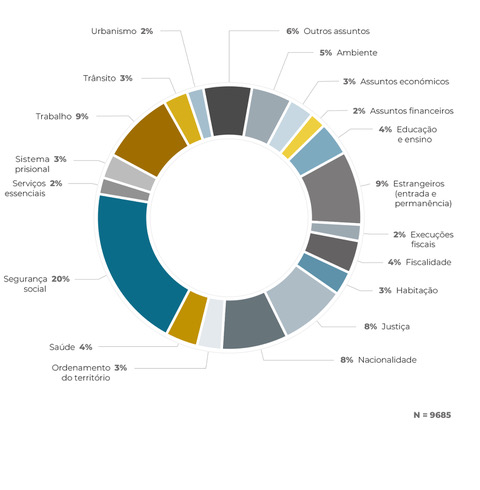
In 2025, the institution received complaints from 15,342 people, representing a 30.1% increase compared with the previous year. During the same period, 9,685 complaint cases were processed, an increase of 6.6% compared with 2024.
This significant increase occurred in a year marked by a prolonged vacancy in the office of the Ombudsperson. It may nevertheless be regarded as an indication of the institution’s strong standing within the community and of the confidence placed in its role in safeguarding rights. Despite the vacancy, the institution maintained its regular operations, examining complaints, engaging with public authorities and informing citizens of the outcomes of its interventions.
The vacancy did, however, prevent the exercise of certain important statutory powers vested in the Ombudsperson, notably the power to issue formal recommendations and to exercise powers to initiate constitutional and legality review proceedings before the Constitutional Court, both in cases of abstract review of legislation and in cases of legislative omission.
The inability to exercise these powers over such a prolonged period therefore represented a significant anomaly in the functioning of the system of checks and balances.
Structure and highlights
As in previous years, drawing on information gathered through complaints concerning various public administration bodies and services, the Report identifies a general issue of systemic concern. In the year marking the 50th anniversary of the 1976 Constitution of the Portuguese Republic, particular attention was given to the way in which public administration interacts with citizens. The Report highlights instances of maladministration and deficient administration that undermine basic standards governing the functioning of public services, including respect for the procedural safeguards afforded to individuals. It also highlights the Ombudsperson’s broad and sustained intervention in the field of children’s rights.
The Report demonstrates that the protection of children’s rights frequently depends on addressing problems affecting families’ living conditions. The complaints examined include cases concerning insufficient or delayed responses in the provision of social housing; the demolition of precarious structures in informal settlements without prior guarantees of alternative accommodation for families with children; delays and difficulties in the granting of social benefits and parental leave allowances; and challenges in reconciling family and professional responsibilities.
The Report also provides a carefully selected overview of issues examined by the institution. Through concise accounts of the handling of complaints in individual cases, it identifies problems in relation to which the Ombudsperson’s intervention extended beyond the resolution of individual cases and sought to contribute to improving administrative action and practice.
The breadth and diversity of the issues addressed — ranging from the environment and spatial planning to matters of citizenship and employment, as well as taxation and issues relating to justice and internal security — reflect the broad scope of the Ombudsperson’s mandate.
These issues were also addressed in a follow-up report on the institution’s previous assessment of public-facing services. During the same year, the Ombudsperson’s Office also published a thematic report on noise, identifying noise as a specific public health concern.
Finally, the Report includes a substantial body of statistical data supporting and illustrating the findings presented.
National Preventive Mechanism
Throughout the year, the National Preventive Mechanism (NPM) strengthened its monitoring of the activities of law enforcement authorities in relation to the entry and stay of foreign nationals, as well as its monitoring of police facilities. Particular attention was paid to detention conditions, procedures for lodging complaints, access to healthcare, and the identification of persons in situations of particular vulnerability.
The protection of children and young people is also reflected in the NPM’s work. Within the scope of its mandate, the NPM monitors places where persons are deprived of their liberty or subject to restrictions on their liberty.
In this context, the NPM Report highlights the monitoring of educational centres within the juvenile justice system and visits to residential units within the child protection and promotion system. This work resulted in the publication of a thematic report on specialised care for children and young people, which was subsequently presented publicly.
- Ombudsperson’s 2025 Activity Report [in Portuguese only]
- National Preventive Mechanism 2025 Report [in Portuguese only]